Noun (Basic ㊦ 257)
The speaker presents some situation as if it were a tangible object.
Equivalent: Because; how could ~!; used to; should like to; should
| (i) {Vinformal/Vますたい} | ものだ | |
| 話すものだ | Someone should talk | |
| 話したものだ | Someone used to talk | |
| 話したいものだ | Someone would like to talk | |
| (ii) {Adjective い/な} informal | ものだ | |
| 高いもの | ‘cause something is expensive | |
| 高かったもの | ‘cause something was expensive | |
| 高かったものだ | Something used to be expensive | |
| 静かだもの | ‘cause something is quiet | |
| 静かだったもの | ‘cause something was quiet | |
| 静かだったものだ | Something used to be quiet |
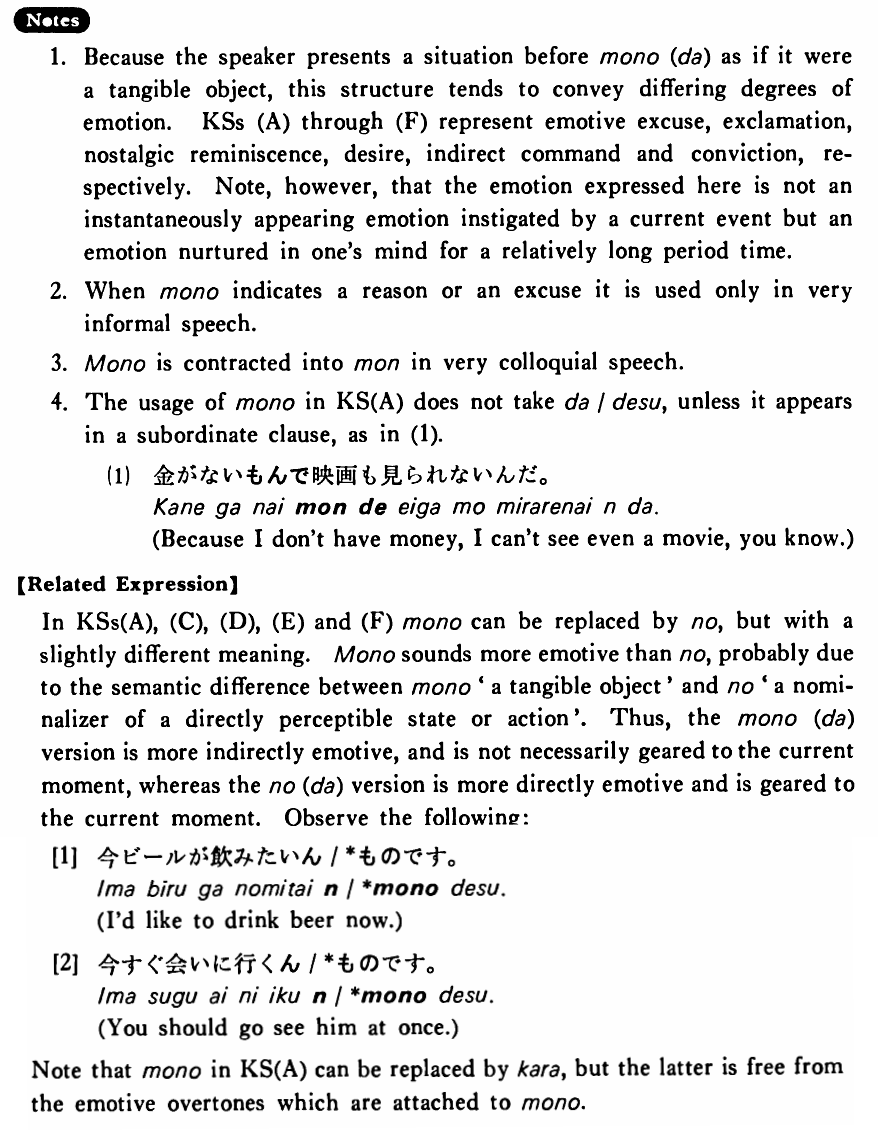
1. Because the speaker presents a situation before もの(だ) as if it were a tangible object, this structure tends to convey differing degrees of emotion. Key Sentences (A) through (F) represent emotive excuse, exclamation, nostalgic reminiscence, desire, indirect command and conviction, respectively. Note, however, that the emotion expressed here is not an instantaneously appearing emotion instigated by a current event but an emotion nurtured in one's mind for a relatively long period time.
2. When もの indicates a reason or an excuse it is used only in very informal speech.
3. もの is contracted into もん in very colloquial speech.
4. The usage of もの in Key Sentence (A) does not take だ/です, unless it appears in a subordinate clause, as in (1).
【Related Expression】
In Key Sentences (A), (C), (D), (E) and (F) もの can be replaced by の, but with a slightly different meaning. もの sounds more emotive than の, probably due to the semantic difference between もの 'a tangible object' and の 'a nominalizer of a directly perceptible state or action'. Thus, the もの(だ) version is more indirectly emotive, and is not necessarily geared to the current moment, whereas the の(だ) version is more directly emotive and is geared to the current moment. Observe the following:
[1]
[2]
Note that もの in Key Sentence (A) can be replaced by から, but the latter is free from the emotive overtones which are attached to もの.